


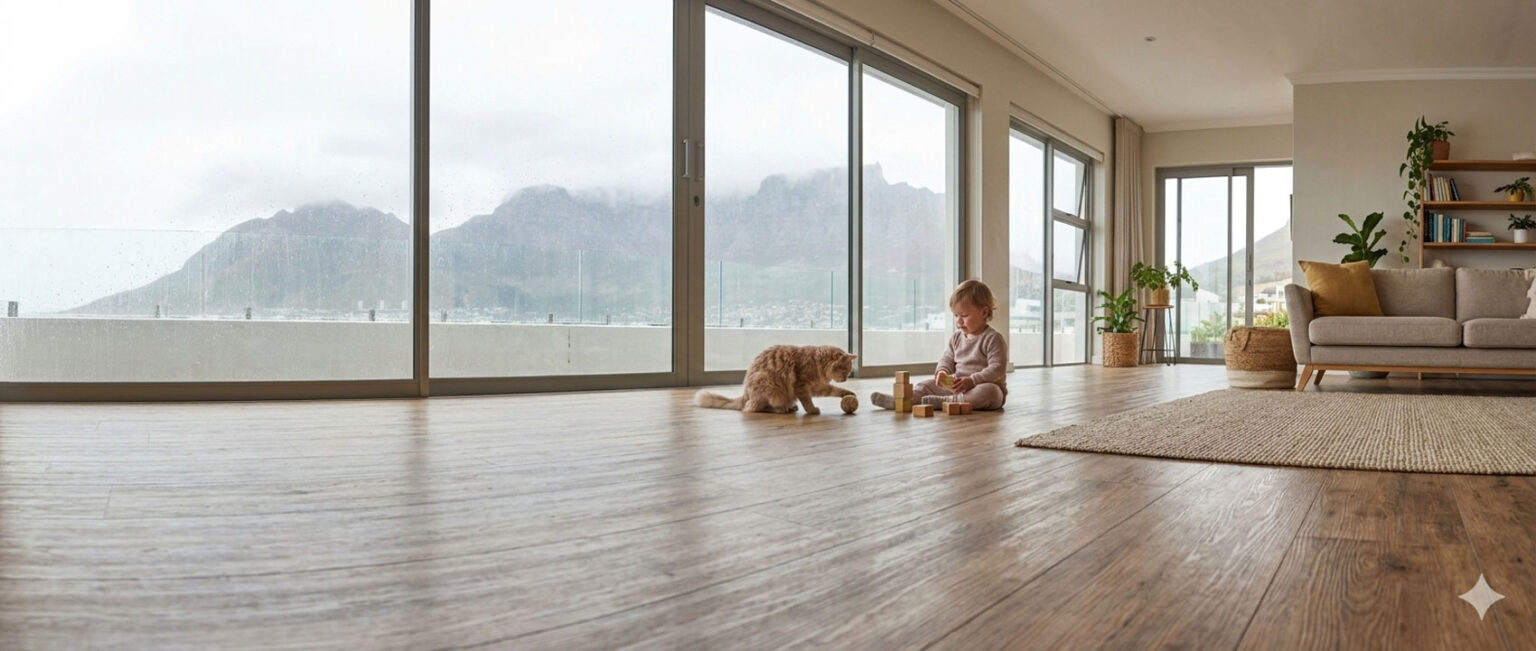
Cape Town’s unique charm comes with its own set of environmental considerations, and for homeowners, one of the most persistent challenges is managing damp and humidity. From the Atlantic Seaboard’s misty mornings to the winter rains across the Southern Suburbs, moisture can wreak havoc on flooring if you don’t choose wisely.
The Reality of the Cape Climate
The “Cape Doctor,” while famous for clearing the air, doesn’t prevent the build-up of moisture, especially in poorly ventilated areas. Many products that promise perfection “on paper” can struggle with the reality of our fluctuating humidity and high-temperature peaks. Choosing the right flooring is about finding products that offer true stability, not just a waterproof label.
Artureon: The Premium Waterproof Laminate (Exclusive)
While traditional laminates were once avoided in damp areas, Artureon by Swiss Krono has completely changed the landscape. We market this range exclusively because it solves the “damp vs. design” dilemma for Cape Town homes.
Unlike standard laminate, Artureon is 100% waterproof, making it a superior choice for kitchens, bathrooms, and moisture-prone ground floors.
-
Superior Stability: Engineered in Switzerland to AC5/Class 33 standards, Artureon offers better dimensional stability than many entry-level rigid core products, meaning it won’t buckle or shift when the humidity spikes.
-
Climate-Tested: It performs exceptionally well in our local climate, offering a more resilient alternative to products that may expand or contract under Cape Town’s intense sun and damp winters.
-
Healthy Home: It is PVC-free and sustainably produced, preventing the mold and mildew issues associated with moisture-trapping materials.
Vinyl & SPC Flooring: High Performance with Care
Vinyl and Stone Plastic Composite (SPC) flooring remain top contenders for moisture resistance. They are virtually impervious to liquid, making them ideal for areas susceptible to rising damp.
However, a word of caution for our local climate: While SPC is marketed as a “rigid core” miracle, experience shows that entry-level SPC can struggle with stability if the subfloor isn’t perfectly flat or if it’s exposed to the extreme heat common in South African summers. For the best results, these products require expert installation and high-quality underlays to prevent joint separation in high-humidity periods.
Engineered Oak: Elegance with a Caveat
For those who dream of real wood, Engineered Oak offers a more stable alternative to solid wood. Its multi-ply core minimizes movement caused by moisture. However, it is not entirely waterproof. In the Cape’s wetter months, proper ventilation and immediate clean-up of spills are essential to prevent the wood from reacting to the ambient humidity.
Bamboo: Sustainable, but Sensitive
Bamboo is celebrated for its hardness and eco-friendliness. While it handles humidity better than traditional hardwoods, it is still a natural product. In extremely damp conditions without proper climate control, bamboo can expand. It is best suited for well-ventilated rooms with moderate humidity levels.
Carpets: Choose Synthetic for Damp Areas
In damp environments, natural fiber carpets can hold moisture and become prone to odors. If you prefer the warmth of carpet, we recommend synthetic fibers like polypropylene. These are inherently more moisture-resistant, dry faster, and are far less likely to harbor mold or mildew during a wet Cape winter.
Beyond the Floor: Artificial Grass
Don’t forget the exterior! Our artificial grass manages external damp by preventing muddy patches from forming near entrances. This keeps your indoor floors dryer and cleaner, acting as the first line of defense against the Cape Town rains.